|
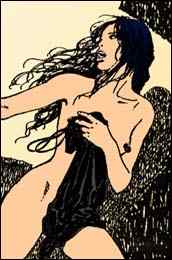
Engañosa Morpeguite,
Fada do doce mírar;
Filla ligeira da brétoma,
De corpo leve e lanzal;
Presurosa compañeira,
Da virazon da miñan:
Lévenm' os demos, s' agora
M' has de volver a escapar;
Nin outra vez, com' anguía,
Te m' has d' escorrer das mans.
—Mira, 'státe quedo Mouco,
Mouco non me fagas mal;
Se me soltas che prometo,
M' obrigo de che contár,
Quen repousa n' Arca d' Ogas,
Desd' a nosa antiga edá;
Non me préndal' a faldra de brétoma,
Déixame, Mouco, vagar.
—Fora léria... As tuas mentiras,
Cansado estou d' escuitar;
En tí curaréi á forza,
As suidades d' aquel mal,
Que deixas na alma, cando,
Correndo soes pasar.
Hei de fartárme de tí,
Ch' o juro por miña nai;
Coma' un oso q' atopa famento,
De mel un doce panal.
|
Sly Morpeguite,
Fairy lady of sweet gaze,
Fleet-footed daughter of the fog,
Slender and light-bodied,
Scurrying companion
Of the morning wind-shift line:
May the demons take me if this time
You elude my grasp once more,
You will not wriggle out of
My hands like an eel again.
"Look, Mouco, keep still.
Mouco, do me no harm.
If you let me go I promise
I'll be obliged to tell you
Who rests in the Ark of Ogas
Since our ancient days of yore.
Don't grab my skirt of fog,
Mouco, let me wander away."
"Humbug...I'm weary of
Listening to your lies.
By force I shall cure in you
The yearnings of that distress
You leave in the soul when
You come running by,
I shall satisfy my hunger of you
(I swear it by my own mother)
As does a hungry bear that finds
A sweet honeycomb."
|