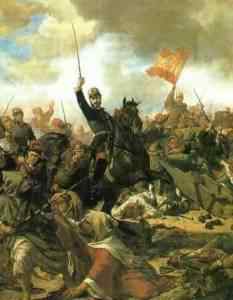
Battle of Tetouan in 1860


1.   Bell of Anllons     (E tí, campana d' Anllons)

(Album de la Caridad, 1862)


Historical Background

On October 22, 1859, after protracted harassment of the Spanish garrisons at Ceuta and Melilla, President Leopoldo O'Donnell declared war on Mohammed the Fourth, Sultan of Morocco. The Spanish people reacted enthusiastically in favour of the war and many thousands volunteered to fight. The Spanish offensive captured Tetouan and Tangier and forced the formal surrender of the Moroccan side on April 26, 1860.


Localities


Translator's Notes

"E tí, campana d' Anllons" contains several reverse sentences (4.1-4, 5.2-3, 8.2-3, 10.3-4, 11.3-4, 12.1-3, 12.4-5). A reverse sentence barters logical order for rhyme or a baroque style. For example the lines, "How often did the captive man from Bergantiños on the African sea hear your sovereign pealing in unyielding dreaming" (4.1-4) are a rewording of the original, "How many (times) on the African sea, captive man from Bergantiños, heard he in unyielding dreaming your sovereign pealing." The original is replete with ambiguity, it would seem that the captive man from Bergantiños does the sovereign pealing and someone else on the African sea hears him. Confusing reverse sentences were restructured upon translation.

That sundered (6.4). The literal translation, With which you sundered, is redundant; rhyme (6.3, 6.4) is the sole reason for Pondal's use of this awkward reflexive phrase.

A synonym was used to translate the second instance of the following words,


Explanation of some words, terms or expressions

St. John's bonfire (8.2). A bonfire lit on the night of St. John's Eve for celebration.


Youtube

Eduardo Blanco Amor (Buenos Aires: July 24, 1956)


«E tí, campana d' Anllons,
Que vagamente tocando,
Derramas nos corazons,
Un bálsamo triste e brando,
De pasadas ilusións.

Alá nos pasados ventos,
Primeiros da miña vida,
Oyo os teus vagos concentos,
Reló dos tristes momentos,
Da miña pátria querida.

¡Cántas veces te lembróu,
O que marchóu para a guerra,
Cando á súa nai deixóu;
E partindo á estraña terra,
De Baneira t' escuitóu!

¡Cántas do mar africano,
Cautívo bergantiñan;
Oío n' hun soño tirano,
O teu tocar soberano,
Aló nas tardes do vran!

Cando te sinto tocar,
Campana d' Anllons doente,
N' unha nuite de lunar...
Rompo triste a suspirar,
Por cousas d' un mal ausente.

Cando doída tocabas,
Pol-as tardes á oracion,
Campana, sempre falabas,
Palabras con que cortabas,
As cordas do corazon.

Estabas contando ós ventos,
Cousas do meu mal presente;
Os meus futuros tormentos,
Que dabas con sentimentos,
Segun tocabas doente.

Campana, se pol-o vrán,
Ves lumiar na Ponte-Ceso,
A cachéla de San Joan;
Dílle a todos que estóu preso,
Nos calabozos d'Orán.

E a aquela rula inocente,
Que me morría d' amor,
No regazo docemente,
Tembrando com' unha fror,
Sobre escondida corrente;
Diráslle, que unha de ferro,
Arrastro, rouca cadéa,
Castigo atroz do meu erro;
E que dentro d' este encerro,
O seu amor me aluméa.

E tí, golondrina errante,
Dos longos campos d' Argel;
S' a miña terra distante,
Te leva o voxo constante,
Dílle o meu penar cruel.

S' alguén por min preguntar,
Dille que estou en prisións;
E unha nuite de lunar,
Iráste unha vés pousar,
No campanario d' Anllons.»

Así triste en terra alléa,
Aló nas prisions d' Orán,
Cantaba un mozo d' aldéa;
E nos grillons da cadéa,
Levaba ó compás ca man.

«Oh nai da miña vida,
Adios, adios, meu pai;
Prenda de min querida,
Adios, oh miña nai:
Sombras dos meus avós,
Río da Ponte-Ceso,
Pinal de Tella espeso,...
Acordávos d' hun preso,
Como él o fai de vós:
Campana de Anllons,
Noites de lunar,
Luna que te pós,
Detrás do pinar;
Adios...
Adioos...
Adiooos...»

"And you, bell of Anllons,
That ringing in vague tones
Pours on every heart
A mellow and sad balsam
Of past illusions.

"Lo on the spent winds
Of the first years of my life
I hear your vague recitals,
Clock of the sad occasions
Of my beloved homeland.

"How often he remembered you
Who marched off to war
Leaving his mother behind
And departing for a foreign land
Listened to you from Baneira!

"How often did the captive man of
Bergantiños hear on the African sea
Your sovereign pealing
In unyielding dreaming
Of summer afternoons back when!

"When I sense you pealing
On a night of bright moonlight,
Aching bell of Anllons,
I break out in sad sighs
Over matters of an absent ailment.

"When you beckoned forlorn
To prayer in the afternoons,
Bell, you always uttered words
That sundered
The cords of the heart.

"You were relating to the winds
Details of my present woe—
The future sufferings of mine—
With the sentiments you transmitted
As you rang out dolefully.

"Bell, if in the summer season
You should spy St. John's bonfire
Burning at Ponte-Ceso
Inform everyone that I am jailed
In the prison cells of Oran.

"And to that innocent dove
Who used to die of love
On my lap tenderly—
Quivering like a flower
Over hidden brook—
You will say that I drag
A grating iron chain behind me
(Terrible punishment for my error)
And that in this confinement
Her love affords me light.

"And you, wandering swallow
Of the sprawling fields of Algeria,
If your constant flight takes you
To my distant homeland
Relate my cruel suffering to it.

"If someone inquires about me
Tell him that I am in jail
And go perch one time
On a night of brilliant moonlight
At the belfry of Anllons."

Thus sang a country boy
Grieving on alien land
Far away in the prisons of Oran
As his hand tapped a beat
On the couplings of the chain.

"O mother of my life,
Good-bye, good-bye my father;
Dear sweetheart of mine,
O mother of mine good-bye,
Shadows of my grandparents,
River of Ponte-Ceso,
Dense stand of pine in Tella...
Remember a prisoner
As he remembers you;
Bell of Anllons,
Nights of bright moonlight,
Moon that sets
Behind the pine grove,
Good-bye...
Goood-byye...
Gooood-byyye..."