Translator: Eduardo Freire Canosa
(University of Toronto Alumnus)
I grant the translations herein to the public domain
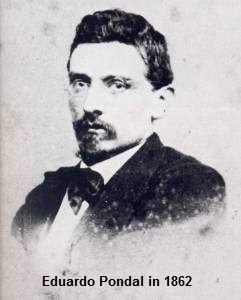
Eduardo Pondal (b. 1835, d. 1917) is the second eminent poet of Spanish Galicia (also known as Galiza).1 He too was highly educated. He obtained the equivalent of a high-school diploma with pre-university training in medicine and surgery from the University of Santiago de Compostela (April 6, 1859) plus the equivalent of a Doctor of Medicine degree from the same university a year later (June 18, 1860) and the equivalent military rank of health care officer after passing tough entrance examinations at the military academy of health care in Madrid (1861 or 1863, sources vary). He served at the naval base of Ferrol and in the huge weapons factory at Trubia in the Spanish region of Asturias (also known as Asturies). After a month of service in Trubia he was granted leave of absence to attend to an urgent family matter, he never returned.
Pondal's decision to abort his medical career may have been an act of conscientious objection. On March 2, 1856, he had helped to organize a revolutionary banquet of camaraderie between liberal students and workers in Conxo where class conventions were laid aside and the students waited on the workers. Aurelio Aguirre and Eduardo Pondal wrote separate toasts for the gathering. Aguirre's proposed that all men were equal because Christ willed the unity of the human family and that as equals the workers and the people should defend their liberty and their rights. Pondal's reply also based the equality of men on religious principle but his tone was more aggressive,
|
And you the people who suffer resigned, |
The social repercussion of the toasts and banquet was enormous. Pondal and Aguirre narrowly escaped exile to the Northern Mariana Islands and they made a partial retraction.3,4 The retractions coincided with the consolidation of the Conservative coup d'état staged by general Leopoldo O'Donnell in July. The Conservatives returned general Narváez to the presidency in October of the following year (1857). This general had been responsible for the bloody suppression of the Liberal uprising of 1846.
Every writer of the Galician Literary Renaissance or Rexurdimento was deeply affected by the failed Liberal uprising of 1846.5 On April 2, 30-year-old colonel Solís the commander of the garrison in Lugo rebelled against President Narváez. There was widespread support for the insurrection in the cities, a Galician government was stitched together hurriedly, vestiges of the central government and its regime of taxation were abolished and the promise was made that Galicia would cease to be treated like a colony. Narváez suppressed the insurrection swiftly and many involved in the rebellion were executed without trial. They came to be known as "the martyrs of Carral." These dead became the triggering pin of the Rexurdimento. On April 23, 1899, Pondal contributed the following poem to a fund-raising campaign to erect the cenotaph that stands today in Carral,
|
Cando m'o referíno,
Durmide, héroes, durmide;
Que s'á vida volvérades, |
When they mentioned it to me—
Sleep, heroes, sleep;
For if you were to return to life, |
|
Youtube: The Failed Liberal Uprising of 1846
Youtube: Remembered In 2010 |
Pondal went from Trubia to Ponteceso in 1864. He was a happy man in the countryside that enchanted him so (poem 8). Naturally the friends he had made and the locales he had visited during his student years pulled him away to Santiago de Compostela on occasion. He also became a regular patron of the "Cova Céltica" (Celtic Cave) symposia held in a bookstore of the city of A Coruña where old friends like Manuel Murguía and new ones met for animated discussions on the future of Galicia and of Galician literature. Murguía acquainted him with the writings of the Scottish bard James Macpherson (b. 1736, d. 1796) and the Ossian cycle of poems became the second major influence on Pondal's literary imagination, the first being the voluminous work of poetry entitled "Os Lusíadas" written by the Portuguese bard Luiz Vaz de Camões (b. 1524, d. 1580). Pondal had these two mentors in mind when he wrote the two verses, "The time of the ages of bards has arrived" (poem 9, 4.1-2).
|
Youtube: James Macpherson
Youtube: Luiz Vaz de Camões |
On February 9, 1902, the city of A Coruña welcomed enthusiastically a minstrel group of university students7 from Porto. Pondal contributed the following poem to Revista gallega where he alludes to the Galician ancestry of Luiz Vaz de Camões,
|
¡ELES...!
Bé-nos conozo:—escrito
De Lusitania fono, |
THEY...!
I know them well—they bear
The hardy chests |
Pondal's lifelong ambition was to pen an epic similar to "Os Lusíadas." His carried the title "Os Eoas" (The Sons of the Sun) but his punctiliousness barred him from finishing the oeuvre to his satisfaction and he died before publishing it, disappointing many of his contemporary readers at home and abroad, yet the failure underscores his commitment to make the Galician language a vehicle for literary masterpieces comparable to Camões' and thus to gain for it redemption from the "scurrilous soubriquet" (poem 9, 5.7).
Any public attempt to honour the native language offended the "odious, groveling vermin that commonly crawl on the trails...the deserters of the sweet, dear homeland" (below). These "vermin" refused to speak Galician, ridiculed those who did and demanded that others speak Spanish in their presence. The bard of Bergantiños wrote this acerbic poem to rebuff them, almost certainly returning the verbal abuse that he and other members of the "Cova Céltica" had to put up with now and then.
|
The odious, groveling vermin (As read by Manuel Ferreiro) |
|
Youtube: Speak Galician
Youtube: Ana Kiro |
Pondal lived through the Spanish-American War of 1898.9 His habitual exaltation of the warrior figure (Villafañe in poem 8, Leonidas in poem 10) led him to write a panegyric to a Spanish general named Valeriano Weyler. This general was so popular that Melchor Bordoy composed an anthem in his honour in 1897, the same year that Pondal wrote this tribute. Weyler removed many Cuban peasants from their villages and interned them in overcrowded facilities guarded by troops, a policy he dubbed "reconcentration." As a result of his policy hundreds of thousands of Cubans died of starvation or disease. General Weyler was the father of the modern internment or concentration camp.
|
A VALERIANO WEYLER
Muitos qu'ás tuas ordes pelearon, |
TO VALERIANO WEYLER
Many who fought under your command |
The first issue of Revista gallega that circulated after the declaration of war on April 25, 1898, mirrored the jingoism that swept Spain. The poem that Pondal contributed to this issue was restrained and addressed the convenience of persuading France to join the war as an ally by pointing out the risk to "la douce et belle Martinique...et sa soeur pure et magique" (i.e. La Guadeloupe) posed by an expansionist United States of America. Pondal wrote this poem in French,
|
AUX FRANÇAIS
Eh quoi ! Révant des nouveax vols,
La douce et belle Martinique
Français, qu'est ce que nous entendons ? |
The sour and argumentative mood that followed defeat spawned the literary "Generación del 98" in Spain. Pondal took the outcome of the war in stride and tried to cheer up his readers with a short humorous poem,
|
¡Viva Beba!
Meus boos amigos:—¡Arriba! |
Long Live "Have A Drink"!
My good friends, liven up! |
In the midst of the war 63-year-old Pondal who lived in the city of A Coruña sent this letter to his last surviving sister (Josefa) who lived in Ponteceso. True to his word he wrote in Galician, true to his profession he gave her this medical advice,
As far as that slight swelling you have on the instep and on the lower shin it is an insignificant matter of little importance. That is a simple edema that usually affects women who venture little outdoors and it is not a symptom of a serious affliction [...]
My opinion is that you must wash your legs and feet with an infusion of leaves and small stems from the following plants growing in that orchard: rosemary, lemon balm, lemon verbena.
Place a small piece of cloth soaked in that water over the swollen area and wear a compression stocking. You can also drink [125 ml] of Mondariz water or of beer, I will be happy to send you the one out of the two which you prefer.
This and taking a walk outdoors around the orchard every once in a while will do you good, a lot of good.
Drink a good glass of milk with every chocolate and exercise moderately.
With nothing else for today, here is your very affectionate brother wishing that you keep well,
Eduardo.13
By 1903 he too was feeling the weight of years and he showed his fatigue in this short poem written in Ponteceso perhaps influenced by the delicate health of his sister,
|
Cando sin apoubigo e sin conforto,
Cando pl'a dura ruta, laso e esmorto
—Oh, Dios! Canto dolor, canta amargura,
Cavade unha gran fosa—cava forte, |
When without peace of mind and comfortless
When I walk the hard route feeble and disheartened,
"O God! How much pain, how much bitterness,
Dig a large grave, dig hard, |
In 1908 Pondal took up permanent residence in a hotel of the city of A Coruña. He rejected cataracts surgery and went totally blind. He died in the hotel on March 8, 1917. The owner donated a wreath and an ample hall for the wake. City Hall donated the burial plot. The Galician Academy, the "Irmandade dos Amigos da Fala," the mayor, city council, mace-bearers, bailiffs, municipal guards in gala uniform and representatives from a long list of local organizations including the Chamber of Commerce, the Centro Castellano, the Casino Republicano, the Circulo Conservador, the Academy of Medicine and the Law School plus a large crowd of citizens accompanied the casket to the graveyard. There were also delegations and wreaths from expatriate centers in Havana and Buenos Aires. Every important building of the city placed black drapes or hung big, black bows from its windows or its balconies. Every shop on the route closed its doors respectfully as the cortege passed. At the interment several members of the "Irmandade dos Amigos da Fala" sang the Galician anthem (poem 9, 1-4) and impromptu a worker threw several bouquets of violets onto the lowered casket. Funeral services were held four days later on March 12, they were very solemn.15,16
To the Real Academia Galega whose online journals archive is the source for most of the poems shown in the Introduction.
To Galician Wikipedia whose list of places, parishes, municipalities and counties enabled me to discover the namesake of many proper nouns found in Pondal's poems (e.g. "Maroñas" of poem 2).
The Eleven Selected Poems of Eduardo PondalClicking on a number will take you to the corresponding poem right away |
|
1. Bell of Anllons (E tí, campana d' Anllons)
2. Intrepid Maroñas (Despois do duro combate) 3. Neither a Tramp Nor a Thief (Que barba non cuidada!) 4. Night Delivery of Lumber (Pol-o baixo cantando) 5. Sly Morpeguite (Engañosa Morpeguite) 6. Swear You Won't Watch (Á sombra tecida) 7. The Curious Wind Lifted Your Skirt (Ibas gozando no meu tormento) 8. The Dolmen of Dombate (O Dolmen de Dombate) 9. The Pine Trees (Os Pinos) 10. To Die On Downy Bed (Morrer en brando leito) 11. Wild Valley of Brantóa (Salvage val de Brantóa) |
| Archived translations from Galician to English of poems by Rosalia de Castro |